
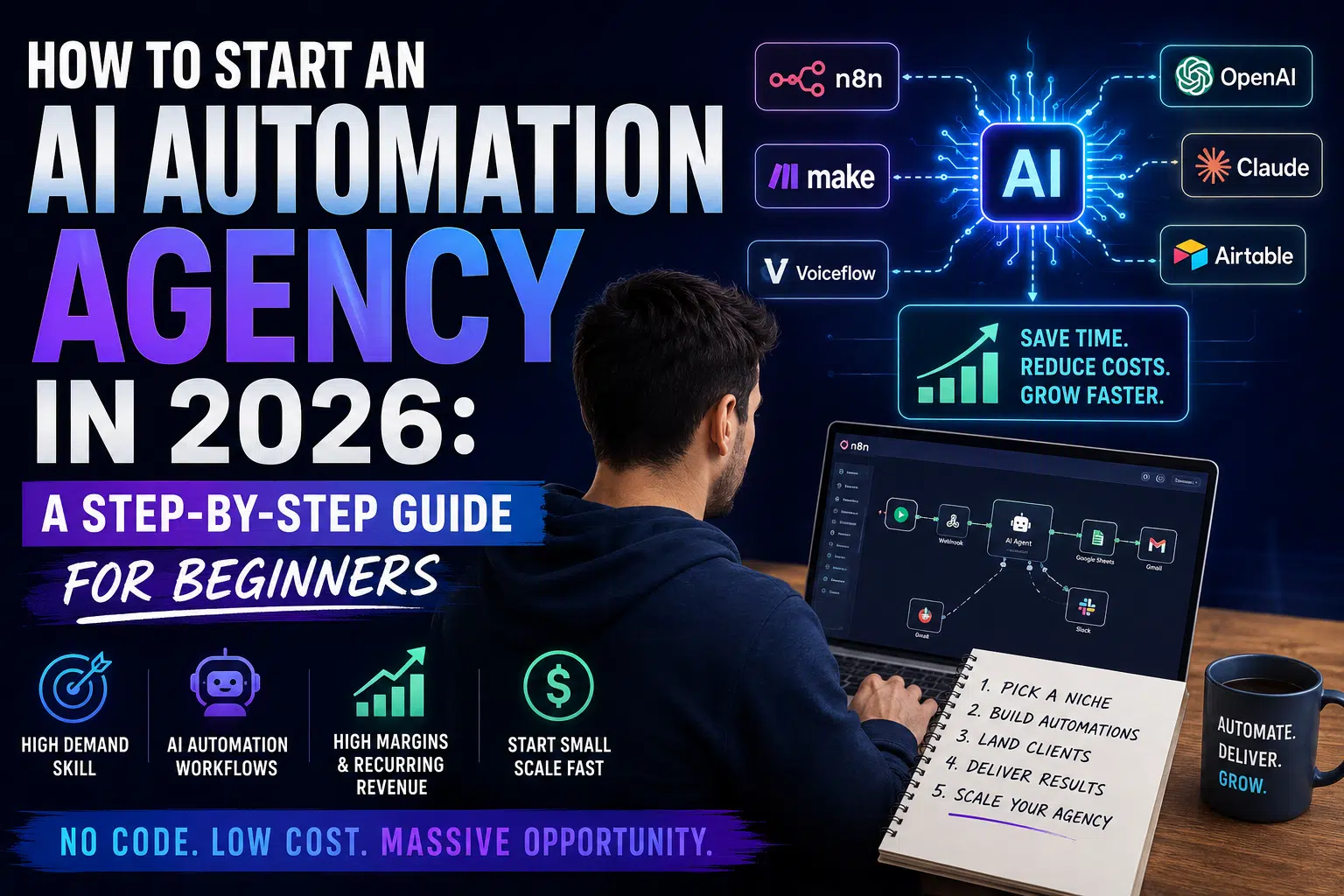
How to Start an AI Automation Agency in 2026: A Step-by-Step Guide for Beginners
The AI automation industry is one of the fastest-growing service businesses of 2026 — and the barrier to entry has never been lower. With no-code tools, accessible AI APIs, and a flood of small businesses desperately looking to cut costs, a single person with a laptop can now launch an agency that competes with traditional consulting firms.
If you've been searching for how to start an AI automation agency, this guide gives you the complete roadmap — from picking a profitable niche to landing your first paying client.
What Is an AI Automation Agency?
An AI automation agency (often called an "AAA") is a service-based business that helps companies replace repetitive manual work with AI-powered workflows. Instead of selling software, you sell outcomes — saved hours, faster response times, qualified leads, and reduced payroll.
Think of it as the modern version of a digital marketing agency, except instead of running ads, you build invisible systems that run a client's business in the background.
Common services include:
- AI chatbots for customer support
- Lead qualification and CRM automation
- Email and outreach automation
- Document processing and data entry workflows
- AI voice agents for booking and inbound calls
- Internal reporting and dashboard automation
Why 2026 Is the Best Time to Start an AI Automation Agency
A few things have shifted in your favour:
- Tools are mature. Platforms like n8n, Make.com, and Voiceflow let you build serious workflows without writing code.
- AI APIs are cheap. Claude, GPT, and open-source models cost pennies per task.
- Small businesses are panicking. Most owners know AI can save them money — they just have no idea where to start.
- The market is huge. Nearly every SMB on earth has at least 5 processes ripe for automation.
This gap — between what businesses need and what they can build themselves — is exactly where you make money.
Step 1: Pick a Profitable Niche
The single biggest mistake beginners make is trying to be "the AI person for everyone." Generalists struggle. Specialists thrive.
Pick one industry where you understand the workflow well enough to spot expensive bottlenecks. Some of the most lucrative niches in 2026:
- Real estate — lead follow-up, tenant screening, property inquiry automation
- Law firms — contract review, document sorting, client intake
- E-commerce — order tracking ("WISMO") support, returns processing, upsell flows
- Healthcare clinics — appointment booking, insurance verification, patient triage
- Marketing agencies — backend AI ops for creative agencies that hate spreadsheets
- Solar and HVAC — quote generation, lead qualification, dispatch scheduling
Choose a niche where your automation can save the client real money — ideally $40,000+ per year in labour or lost revenue. That makes pricing easy.
Step 2: Define Your Core Service Offers
You don't need 20 services. You need 2–3 you can deliver reliably.
For a beginner, this stack works well:
- AI Lead Qualification System — captures leads, scores them, books qualified calls automatically
- AI Customer Support Agent — handles tier-1 support tickets and FAQ responses
- Workflow Automation Build-Out — connects the client's CRM, email, and tools into one pipeline
Each of these solves an obvious, expensive problem — perfect for sales conversations.
Step 3: Choose Your Tools
You can launch a complete AI automation agency for under $200/month in tools.
The essential stack:
- n8n — the 2026 favourite for complex, self-hosted automation workflows
- Make.com — best beginner-friendly alternative ($9–$29/month)
- Anthropic Claude API or OpenAI API — your AI backbone (~$50–$100/month for client work)
- Voiceflow — for building AI chatbots and voice agents
- Airtable or Notion — client-facing dashboards
- A small VPS (Hetzner, $5–$10/month) — to host n8n and custom agents
Skip Zapier for serious work. It's fine for tiny linear tasks but the per-task pricing kills you at scale.
Step 4: Set Your Pricing
Stop charging hourly. AI automation agencies charge based on value delivered, not time spent.
The standard 2026 pricing model is setup fee + monthly retainer:
- Setup fee: $1,500–$5,000 for simple builds, $5,000–$15,000+ for multi-system integrations
- Monthly retainer: $500–$2,000/month for maintenance, optimization, and minor tweaks
Why retainers matter: APIs change, prompts need tuning, new use cases emerge. Retainers give the client peace of mind and you predictable recurring revenue.
A simple pricing benchmark: if your automation saves the client $40,000/year in labour, charging $8,000 setup + $1,500/month is a no-brainer for them. They break even in under 6 months and save tens of thousands every year after that.
Step 5: Build a Demo (Before You Build a Website)
You don't need a fancy website, a logo, or an LLC to start. You need one working demo.
Pick a real automation problem in your chosen niche, build the solution, record a 2-minute Loom video walking through it, and use that demo as your sales asset.
Examples that close clients fast:
- An AI agent that watches a Gmail inbox, qualifies leads, and books them on Calendly
- A WhatsApp bot that answers customer questions using a client's product catalogue
- A workflow that turns voicemails into CRM entries with summary, sentiment, and next-step suggestions
When prospects see something working — not slides, not promises — they buy.
Step 6: Land Your First Client
Most founders land their first $5,000–$10,000 client within 3–6 weeks of consistent outreach. Here's the playbook:
- Start with your network. Almost everyone knows someone running a small business with painful manual work. Offer a free 30-minute audit.
- Lead with the problem, not the technology. "How many hours does your team waste copying data between tools?" beats "I build AI pipelines."
- Use search intent platforms. Search Reddit, X, and LinkedIn for posts like "How do I automate [task]?" or "Tired of manually entering [data]." These people are actively shopping for a solution.
- Run a paid pilot. Offer a small, fixed-scope first project ($500–$1,500) to remove the risk for hesitant clients. Most paid pilots convert into full retainers.
Step 7: Deliver, Document, Scale
Once you have a client:
- Document everything. Turn each build into a reusable template you can deploy faster next time.
- Get a case study. "We saved a real estate agency 23 hours/week" is your most powerful sales asset.
- Raise prices on every new client. By client #3, you should be charging double what you charged client #1.
By the time you're running 5 retainers at $1,500–$2,500/month plus setup fees, you're at a $10,000+/month business — solo, with no employees.
Common Mistakes to Avoid
- Selling "AI consulting." Clients don't know what that means. Sell concrete outcomes.
- Using Zapier at scale. It gets expensive fast. Move to n8n or Make as soon as you have one paying client.
- Pricing by the hour. You'll cap your income and signal that you're a freelancer, not an agency.
- Trying to serve every industry. Pick one. Master it. Expand later.
- Building before you sell. Get a verbal yes before you build the system.
How Much Does It Cost to Start an AI Automation Agency?
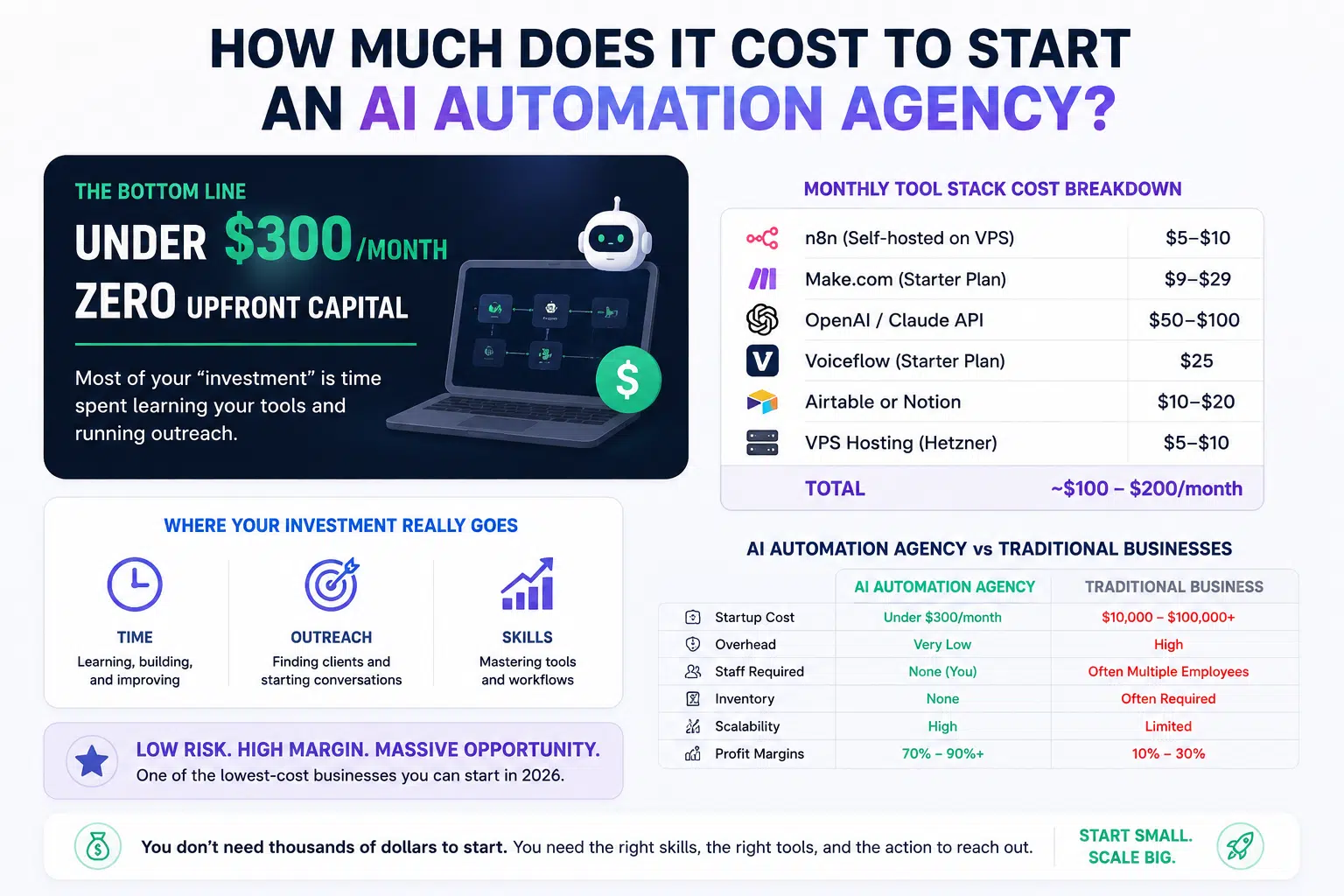
Realistically, you can launch with under $300 in monthly tool costs and zero upfront capital beyond that. Most of your "investment" is time spent learning your tools and running outreach.
Compared to traditional businesses requiring inventory, staff, or office space, an AI automation agency is one of the lowest-risk, highest-margin businesses you can start in 2026.
How to Validate Your Niche Before Committing
Choosing a niche should involve more than selecting an industry that appears profitable. Before committing, speak with real business owners and confirm that the problem you plan to automate is frequent, expensive, and important enough to solve. Start by interviewing five to ten businesses in your chosen industry. Ask how they currently manage leads, appointments, customer inquiries, reporting, follow-ups, and data entry. Look for tasks that happen repeatedly and require employees to move information manually between different systems. A strong automation opportunity usually has the following characteristics:- The task is performed several times per week
- The existing process is slow or prone to errors
- Delays result in lost leads, revenue, or customer satisfaction
- The business already pays employees to complete the work manually
- The result can be measured using time, cost, response speed, or conversion rate
How to Conduct an AI Automation Audit
An automation audit helps you understand the client’s existing workflow before recommending technology. The goal is to identify bottlenecks, unnecessary manual work, and opportunities for measurable improvement. During the discovery call, ask the client:- Which repetitive task consumes the most employee time?
- Where do new leads and customer requests come from?
- Which applications does the team currently use?
- Where is information copied manually between systems?
- Which tasks are frequently delayed or forgotten?
- What happens when the process fails?
- How much time does the team spend on the process each week?
- What result would make the automation successful?
A Simple AI Automation Delivery Process
A professional delivery process makes your agency easier to trust and reduces the risk of project delays.1. Discovery
Understand the client’s business, existing tools, pain points, objectives, and limitations. Avoid recommending a platform before understanding the workflow.2. Workflow Mapping
Create a visual map of the current process and the proposed automated process. Confirm the trigger, actions, decision points, data sources, and expected outcome.3. Proposal and Scope
Define exactly what the automation will do. Include deliverables, integrations, project timeline, client responsibilities, revision limits, setup fee, and ongoing support terms.4. Prototype
Build a small working version using test data. Let the client review the workflow before connecting it to live business systems.5. Testing
Test successful transactions as well as failures, missing information, duplicate records, incorrect inputs, and interrupted connections. Important workflows should include error notifications and activity logs.6. Deployment
Connect the approved automation to live systems gradually. Monitor the initial runs closely instead of activating everything at once.7. Documentation and Training
Give the client clear documentation covering how the automation works, which systems it uses, what employees must still do, and who to contact if something fails.8. Maintenance
Monitor performance, update integrations, review AI outputs, fix errors, and improve the workflow as the client’s needs change. This ongoing work can be included in a monthly support plan.How to Measure the ROI of an Automation Project
Clients are more likely to approve automation when the expected value is clearly explained. Start by calculating the cost of the existing manual process:Weekly hours × employee hourly cost × 52 weeks
For example, if a process takes 15 employee hours per week and the estimated labor cost is $25 per hour:
15 × $25 × 52 = $19,500 per year
Then estimate the expected improvement conservatively. Do not assume that every manual hour will be eliminated. Some tasks may still require review, exception handling, or customer communication.
The project may also produce value through:
- Faster response times
- Fewer missed leads
- Reduced data-entry errors
- Better customer experience
- More consistent follow-up
- Improved reporting
- Increased employee capacity
Sample Outreach Message for Potential Clients
Subject: Quick automation idea for [Business Name] Hi [Name], I noticed that your team handles [specific repetitive process]. I created a simple idea that could reduce the manual work involved and help your team respond faster. I would be happy to show you a short demonstration and explain how the workflow could connect with the tools you already use. Would you be available for a brief 15-minute conversation this week? Best, [Your Name] [Agency Name] [Website] Personalize every message using a genuine observation about the business. Avoid sending identical messages to hundreds of companies or making claims about guaranteed savings before completing an audit.Data Security and Responsible AI Automation
Automation agencies may handle customer records, emails, documents, payment information, and other sensitive business data. Security should therefore be included in the project from the beginning. Follow these basic practices:- Request only the system access required for the project
- Use separate client accounts and credentials
- Store API keys securely
- Enable multi-factor authentication when available
- Avoid placing sensitive information inside prompts unnecessarily
- Define how logs and customer data will be retained
- Test permissions before deployment
- Create a process for revoking access after the engagement
- Keep human approval for sensitive or high-impact decisions
When to Use Human Approval
Not every step should be fully automated. Human approval is especially important when an automation:- Sends contracts, refunds, or payment requests
- Makes employment-related decisions
- Handles sensitive customer complaints
- Changes important account information
- Provides medical, legal, or financial information
- Deletes or permanently modifies records
- Sends high-volume external communications
Next Steps
Start with one specific business problem, one clearly defined workflow, and one measurable result. Build a small demonstration, speak with potential clients, and improve your offer based on real feedback. Before selecting your technology stack, compare the best AI automation platforms for small businesses. A professional website can also help explain your offer, demonstrate previous work, and generate qualified inquiries. Explore Brain Studioz’s website design and development services. If your business needs help planning an automation workflow, contact Brain Studioz for a consultation.Final Thoughts
The agencies that win in 2026 aren't the ones chasing every shiny new AI model. They're the ones who deeply understand a single industry, deliver measurable ROI, and build trust through results.
If you can code, you can automate. If you can automate reliably, you can charge for it. The hardest part isn't the tech — it's the sales and the positioning. Everything past your first two clients gets dramatically easier.
Start small. Pick a niche. Build one demo. Have one conversation. The AI automation agency model rewards people who actually start more than people who plan forever.
Frequently Asked Questions
How much can an AI automation agency make? Most solo founders hit $5,000–$15,000/month within 6 months and $30,000–$50,000+/month within 12–18 months with a focused niche and retainer model.
Do I need to know how to code? No. Tools like n8n, Make, and Voiceflow let non-coders build sophisticated workflows. Coding helps for custom edge cases but isn't a requirement to start.
How long does it take to land the first client? Founders doing consistent outreach typically land their first paying client in 3–6 weeks.
What's the best AI tool for an automation agency in 2026? For beginners, Make.com is the easiest. For serious workflows, n8n (self-hosted) is the 2026 standard. Pair either with the Claude API or OpenAI API for AI tasks.
Is it too late to start an AI automation agency? No. The market is enormous and most small businesses haven't even started exploring AI. We're closer to the beginning of the curve than the end.