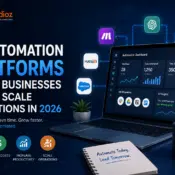
Top AI Automation Platforms for Small Businesses in 2026
Top AI Automation Platforms for Small Businesses in 2026
The best AI automation platforms small businesses can adopt in 2026 are no longer optional — they're essential. According to the SBE Council's 2026 Small Business Tech Use Survey, 82% of small business employers have already invested in AI tools, and the typical small business now uses around five different platforms across marketing, sales, customer service, and operations. The numbers are only growing: 93% of small businesses already using AI plan to keep investing, and 62% intend to increase spending in the next year.
In other words, AI automation platforms small businesses use have crossed the line from "nice to have" to "table stakes." The harder question is no longer whether to adopt them — it's which AI automation platforms small businesses should actually invest in for real returns.
This guide breaks down the AI automation platforms small businesses are using in 2026, organized by what they actually do best. Pick based on the bottleneck you're trying to fix, not the hype.
What AI Automation Platforms Small Businesses Actually Need
A few years ago, automation tools were glorified plumbing — they moved data between apps based on rigid rules. That era is over. Modern AI automation platforms small businesses rely on combine three capabilities in one stack:
- Workflow orchestration — connecting your apps so data flows automatically between them
- AI reasoning — using large language models to read, write, classify, and decide
- Agentic behavior — letting AI handle multi-step tasks with judgment, not just scripts
The platforms below are organized by the job to be done. If you want help choosing the right stack, our team at BrainStudioz builds custom automation systems for small businesses every day.
1. Zapier — Best for Non-Technical Teams Starting Fast
Zapier remains the default choice for small businesses dipping their toes into automation, and 2026 hasn't changed that. With more than 7,000 app integrations, it connects to almost anything you already use — Gmail, HubSpot, Slack, QuickBooks, Shopify, Notion, you name it.
What's new is the AI layer. Zapier Copilot lets you describe an automation in plain English and generates the workflow for you. AI Actions plug language models directly into your Zaps so you can summarize, classify, or draft content as part of an automated flow.
Best for: Solopreneurs and small teams who want automation working today, without learning a new tool.
Watch out for: Pricing scales aggressively. Zapier charges per task (each individual action), so a five-step workflow run a thousand times costs you 5,000 tasks. Complex automations get expensive fast.
2. Make — Best Balance of Power and Price for Small Business Automation
Make (formerly Integromat) sits in the sweet spot between Zapier's simplicity and developer-grade tools. Its visual canvas shows your entire workflow as a flowchart, complete with branching logic, loops, and parallel paths. For small businesses with even one moderately technical person, Make is often the better long-term bet among AI automation platforms small businesses can choose from.
The 2026 update introduced Maia, an AI assistant that builds entire scenarios from natural language descriptions, plus Make AI Agents for autonomous task execution. The free tier is genuinely usable — 1,000 operations per month with two active scenarios — which makes it easy to prove ROI before paying.
Best for: Small businesses with multi-step workflows, conditional logic, or anyone who's outgrown Zapier's task-based pricing.
Watch out for: Steeper learning curve than Zapier. Plan a couple of hours to get comfortable.
3. n8n — Best AI Automation Platform Small Businesses Can Self-Host
n8n is the platform of choice for businesses that want maximum control. It's open source and self-hostable, meaning you can run it on your own infrastructure with unlimited workflow executions and zero per-operation fees.
The pricing model is genuinely different: n8n charges per workflow execution, not per step. A 20-step automation costs the same as a 2-step one. For high-volume use cases, this can be 90% cheaper than Zapier. The platform also leads on AI agent capabilities, with native LangChain integration, 70+ AI nodes, and support for self-hosted models and retrieval-augmented generation.
Best for: Technical small businesses, agencies selling automation services, and anyone with strict data privacy requirements.
Watch out for: Requires technical comfort. Self-hosting adds infrastructure overhead. Skip this if no one on your team can read JSON.
4. Lindy AI — AI-Native Automation Without Code
Lindy is a newer entrant built specifically around AI agents — what it calls "Lindies" — that can handle scheduling, email management, customer support, and multi-step business processes. The interface feels Zapier-like, but the underlying logic is AI-native rather than rule-based.
Pricing starts around $29/month, which is accessible for small teams, and it ships with over 100 pre-built templates so you don't have to start from scratch.
Best for: Small businesses that want AI agents handling real work — meeting prep, inbox triage, lead qualification — without hiring a developer.
5. HubSpot AI CRM — Sales and Marketing in One Platform
If your bottleneck is leads slipping through cracks or follow-ups not happening, an AI-powered CRM may give you more leverage than a horizontal automation tool. HubSpot's AI suite has earned its reputation in 2026 by going beyond contact management — it tells you which leads to prioritize, drafts personalized outreach, and predicts deal outcomes.
For small businesses, the free tier is genuinely useful, and the Starter Suite bundles sales, service, and marketing automation together at a small business–friendly price.
Best for: Small businesses where the biggest pain is sales follow-up, lead nurturing, or fragmented customer data.
6. Tidio with Lyro AI — Customer Support Automation Platforms Small Businesses Love
Customer support is one of the highest-ROI areas for AI automation in small businesses. Tidio combines live chat with Lyro, an AI chatbot that learns from your existing support content — help articles, FAQs, past tickets — and handles common questions around the clock.
The setup is genuinely fast. Most small businesses can have Lyro answering questions within a day, and the pricing is built for small teams rather than enterprises.
Best for: E-commerce stores, service businesses, and anyone whose support inbox is drowning them.
7. ManyChat — Social Commerce and Messaging Automation
If your customers find you on Instagram, WhatsApp, or Facebook Messenger, ManyChat is purpose-built for automating those conversations. It captures leads, answers FAQs, and runs full marketing flows inside the messaging apps where your audience already lives.
Best for: D2C brands, local businesses, and creators selling on social platforms.
8. Mailchimp — Email Automation and Lead Nurturing
Email isn't going anywhere, and Mailchimp's automation has matured significantly with AI. Customer journeys trigger messages based on behavior, AI helps generate subject lines and content, and built-in testing tools let you experiment without spreadsheet gymnastics.
For small businesses focused on owned-audience growth — newsletters, abandoned cart recovery, welcome sequences — Mailchimp connects marketing automation to revenue without heavy technical setup.
Best for: Small businesses with an email list that isn't being worked hard enough.
9. Otter.ai and Fireflies.ai — Meeting and Knowledge Automation
Meetings eat hours. Tools like Otter.ai and Fireflies.ai sit silently in your calls, transcribe everything in real time, and surface action items, summaries, and searchable highlights afterward. For small teams where the founder is in every meeting, this alone can give you back five-plus hours a week.
Best for: Service businesses, consultants, and any team where decisions happen on Zoom or Google Meet.
How to Choose the Right AI Automation Platforms Small Businesses Will Actually Use
The fastest way to fail with AI automation is to pick tools because they're trendy. Here's a simpler approach:
Start with your most expensive bottleneck. Where are you losing time, money, or customers right now? Missed leads? Slow support replies? Manual data entry between apps? Pick one — just one — and automate that.
Match the tool to your team's skill level. If no one on your team can debug a webhook, n8n is going to frustrate you. Zapier or Lindy will get you results faster, even at a higher per-task cost. The cheapest tool you abandon is more expensive than the priciest tool you actually use.
Check integrations before you commit. Whatever AI automation platforms small businesses choose, they have to play nicely with what you already use — your CRM, your email platform, your accounting software. A disconnected automation creates new manual work to bridge the gaps, which defeats the point.
Measure something. Pick a metric — hours saved per week, response time, conversion rate, leads followed up — and track it for 30 days before and after. If you can't see the impact, the automation isn't working.
Build a stack, not a Frankenstein. The small businesses winning with AI in 2026 aren't using the most tools — they're using a coherent set that talks to each other. Five well-integrated platforms beat fifteen disconnected ones every time.
FAQ: AI Automation Platforms Small Businesses Ask About Most
What are AI automation platforms small businesses use most? The most widely adopted AI automation platforms small businesses use in 2026 are Zapier, Make, HubSpot, Mailchimp, and Tidio. The right choice depends on your biggest bottleneck — sales, support, marketing, or operations.
Are AI automation platforms small businesses use expensive? Most platforms offer free tiers or starter plans under $30/month. The real cost comes from picking tools that don't integrate with your existing stack, which creates more manual work than it removes.
Can a non-technical small business actually use these tools? Yes. Platforms like Zapier, Lindy AI, and Tidio are specifically designed for non-technical users. You can set up your first useful automation in under an hour without any code.
Which AI automation platform should I start with? If you're new to automation, start with Zapier or Make. They have the largest integration libraries, the best documentation, and active communities — meaning whatever problem you hit, someone else has already solved it.
The Bottom Line
AI automation platforms small businesses adopt in 2026 aren't about replacing people — they're about removing the work that shouldn't have required a person in the first place. Done well, automation gives small businesses something they almost never have enough of: time to focus on strategy, customers, and the parts of the business that actually grow it.
Pick one bottleneck. Pick one platform from the list above. Automate it this month. Then expand from there.
The companies that grow fastest in 2026 won't be the ones with the biggest teams. They'll be the ones whose teams aren't drowning in busywork.
Looking for help designing an AI automation stack tailored to your business? Get in touch with the BrainStudioz team — we help small businesses move from manual chaos to systems that quietly run in the background.